
Cheapest Places to Rent in the UK 2026

The cheapest places to rent in the UK in 2026 are concentrated in the North East of England, east Lancashire, the Humber estuary, rural Scotland and the South Wales valleys. Hartlepool and Dumfries and Galloway share the lowest average private rent in the country at £558 a month, against a UK average of £1,400 and a London average of £2,332.
This guide covers where rents are lowest at regional, city and local-authority level, how much one-, two- and three-bedroom homes cost in those areas, what the cheapest areas near London, Manchester, Birmingham, Leeds, Liverpool, and Bristol are, and why the lowest headline rent is not always the lowest total cost of living once council tax, energy, and commuting are added.
"Cheap" here means a low average monthly private rent across the whole rented stock in an area, as measured by the ONS. That is different from the asking rent on a newly advertised property, which is usually higher. Both measures are explained below, and every figure is dated and sourced so you can check it yourself.
What Are the Cheapest Places to Rent in the UK?
Direct answer: According to the ONS Price Index of Private Rents for August 2026, the cheapest local areas to rent in the UK are Hartlepool in the North East of England and Dumfries and Galloway in Scotland, both at an average of £558 a month. The North East is the cheapest English region at £788 a month; Wales is the cheapest UK nation at £846.
The data behind this guide
Three different measures of rent are used in the UK, and they are not interchangeable:
| Measure | Publisher | What it counts | Latest figure used here |
|---|---|---|---|
| Average private rent (stock measure) | ONS Price Index of Private Rents (PIPR) | Achieved rents across all existing and new tenancies in England and Wales; mostly advertised new lets in Scotland and Northern Ireland | UK £1,400 (August 2026) |
| Average asking rent (new lets) | Rightmove Rental Trends Tracker | Advertised rents of properties coming to market on Rightmove, 413,574 listings, 1 April–30 June 2026 | £1,397 outside London; £2,791 in London (Q2 2026) |
| Average rent for new lets | Zoopla Rental Market Report | Zoopla's own index of newly agreed rents | UK £1,321 (June 2026) |
The ONS measure is lower than portal figures because it includes long-standing tenants whose rent has not been reset to current market rates. Portal figures show what you will actually be asked to pay when you move. Use ONS data to compare areas fairly; use portal listings to budget for a move.
Limitations to keep in mind:
- ONS local figures are published for local authorities in England and Wales and for Broad Rental Market Areas in Scotland and Northern Ireland. A local-authority average hides big differences between neighbourhoods.
- The ONS advises caution when comparing Scotland and Northern Ireland with England and Wales because collection methods differ.
- Northern Ireland data runs two months behind (latest: June 2026).
- UK figures for July and August 2026 are provisional and may be revised.
- Local monthly movements can be volatile where few tenancies are recorded; longer trends matter more than one month's change.
10 Cheapest Places to Rent in the UK in 2026
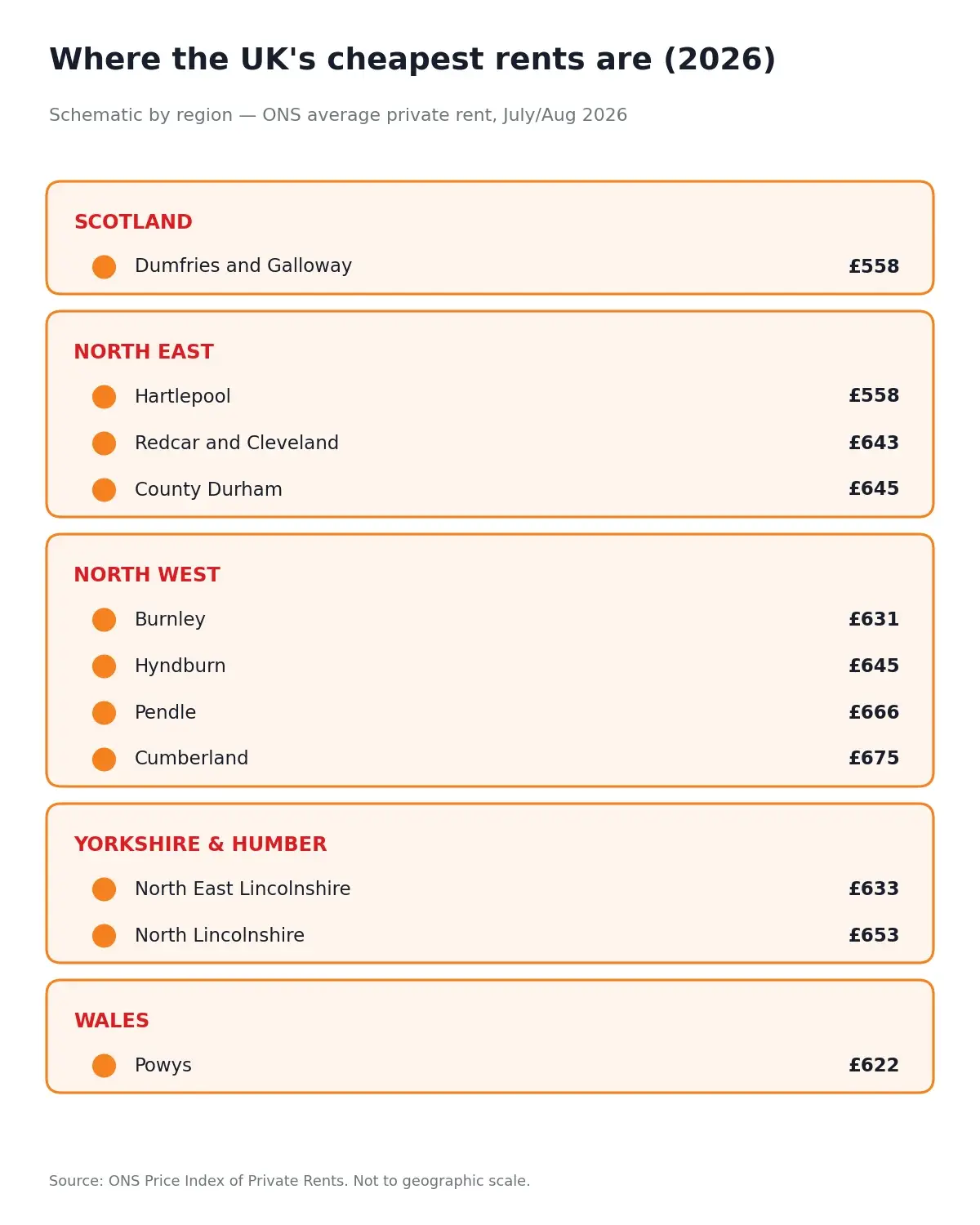
The table ranks the ten cheapest local authorities in England and Wales by ONS average private rent for July 2026, the most recent full local-authority dataset reviewed for this article. Dumfries and Galloway in Scotland (£558, August 2026) would sit alongside Hartlepool at the top of a UK-wide list but is measured as a Broad Rental Market Area rather than a local authority, so it is noted separately.
| Rank | Location | Average rent (ONS, July 2026) | Region / nation | Property context | Why rents are low |
|---|---|---|---|---|---|
| 1 | Hartlepool | £556 (£558 in Aug 2026) | North East | Mainly terraced housing; 2-bed average £509 in Aug 2026 | Small coastal town, low house prices, limited high-wage employment locally |
| 2 | Powys | £622 | Wales | Rural cottages, farmhouses, market-town terraces | Large rural county, low population density, few large employers |
| 3 | Burnley | £628 (£631 in Aug 2026) | North West | Victorian terraces dominate; 1-bed average £465 in Aug 2026 | Former mill town with some of England's lowest house prices |
| 4 | North East Lincolnshire (Grimsby, Cleethorpes) | £633 | Yorkshire and the Humber | Terraces and semis; coastal | Port economy, low land values |
| 5 | Redcar and Cleveland | £643 | North East | Terraces and post-war semis on the Teesside coast | Industrial heritage, low house prices |
| 6 | Hyndburn (Accrington) | £645 | North West | Dense terraced stock | East Lancashire mill-town economy |
| 7 | County Durham | £645 | North East | Mix of ex-mining villages and Durham city | Wide rural county pulls the average down; Durham city itself is pricier |
| 8 | North Lincolnshire (Scunthorpe) | £653 | Yorkshire and the Humber | Terraces and 1970s–90s estates | Industrial town, low demand pressure |
| 9 | Pendle (Nelson, Colne) | £666 | North West | Stone terraces, Pennine-edge towns | Low house prices, commuter link to Burnley/Manchester |
| 10 | Cumberland (Carlisle, Workington, Whitehaven) | £675 | North West | Terraces in Carlisle; coastal towns in the west | Remote from major job markets |
Source: ONS Price Index of Private Rents, local authority estimates, July 2026 (published 19 August 2026), with August 2026 updates for Hartlepool and Burnley from the 16 September 2026 release. Property context is descriptive and based on the dominant housing stock in each area, not an ONS measure.
Two things stand out. Six of the ten are in the North East or east Lancashire, and every one of them has an average rent below half the UK figure of £1,400. Rents in these areas are also rising faster than in the South: the North East and North West both recorded 5.8% annual rent inflation to August 2026, the highest of any English region, while the South East recorded the lowest at 3.0%.
Looking for an affordable rental property? Explore available rental listings on Proptino and compare properties by location, property type and budget.
Cheapest Cities to Rent in the UK
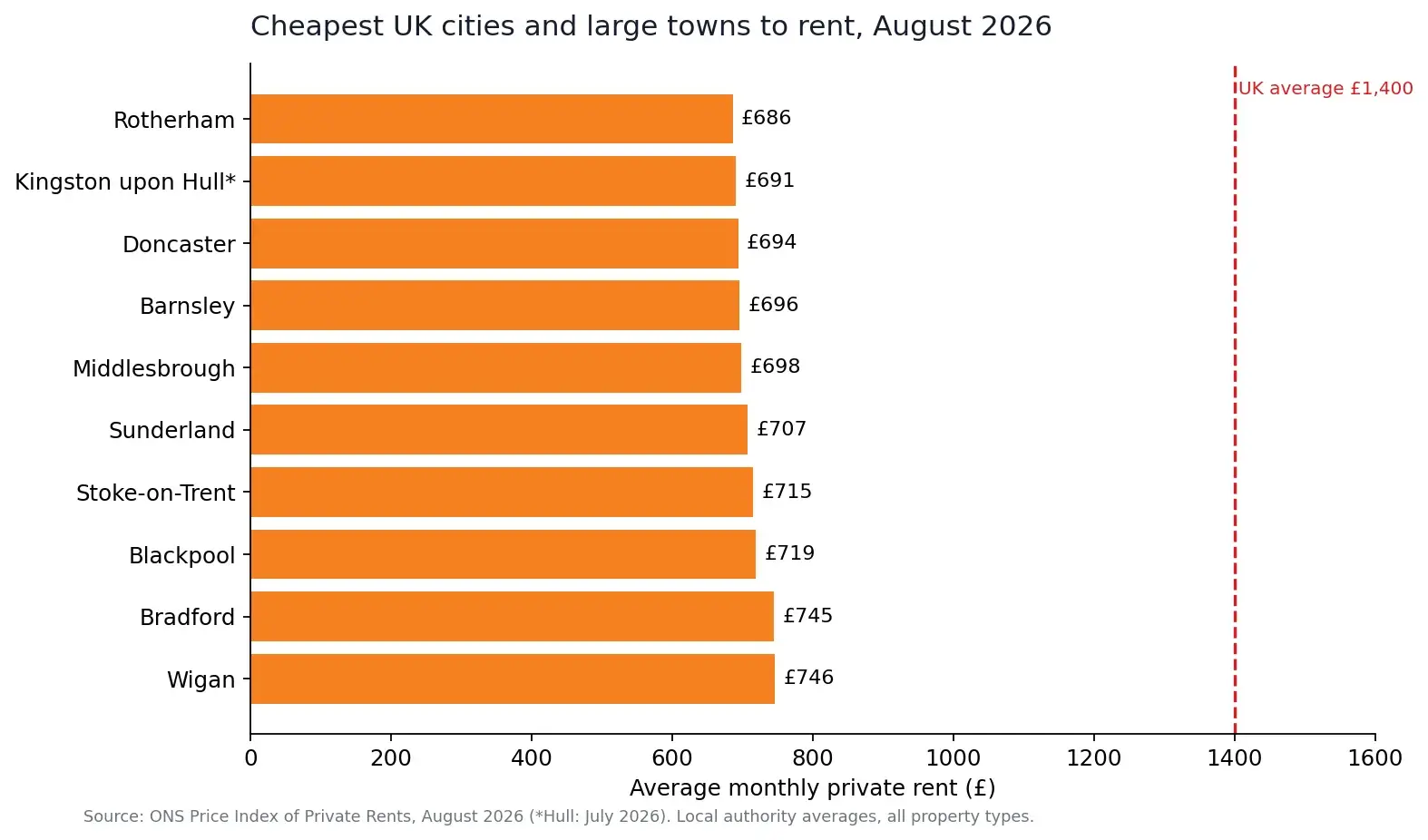
Most of the very cheapest local authorities are towns rather than cities. Among places with city status or a population above roughly 100,000, these had the lowest ONS average rents in August 2026:
| City / large town | Average rent (Aug 2026) | 1-bed | 2-bed | 3-bed | Region |
|---|---|---|---|---|---|
| Sunderland | £707 | £523 | £647 | £773 | North East |
| Middlesbrough | £698 | £499 | £634 | £754 | North East |
| Kingston upon Hull | £691 (July 2026) | — | — | — | Yorkshire and the Humber |
| Doncaster | £694 | £493 | £636 | £757 | Yorkshire and the Humber |
| Barnsley | £696 | £507 | £630 | £753 | Yorkshire and the Humber |
| Rotherham | £686 | £488 | £615 | £743 | Yorkshire and the Humber |
| Stoke-on-Trent | £715 | £518 | £662 | £796 | West Midlands |
| Blackpool | £719 | £501 | £652 | £794 | North West |
| Bradford | £745 | £549 | £675 | £808 | Yorkshire and the Humber |
| Wigan | £746 | £542 | £700 | £838 | North West |
Source: ONS Price Index of Private Rents, August 2026 (Hull figure July 2026). Bedroom figures are ONS averages by number of bedrooms.
What the cheapest cities offer
Sunderland (£707) has a university, Nissan's Washington plant and direct Tyne and Wear Metro links to Newcastle, where rents average £1,215. Renting in Sunderland and working in Newcastle is a common arrangement.
Middlesbrough (£698) and neighbouring Stockton-on-Tees (£735, July 2026) form the core of Teesside. Teesside University and the Teesworks industrial site are the main employers; the Tees Valley is around an hour from Newcastle and Leeds by train.
Hull (£691) is the cheapest city in Yorkshire and the Humber and has a large university and a growing renewable-energy sector around the Humber. It is roughly an hour from Leeds by rail.
Doncaster, Barnsley and Rotherham (£686–£696) are all within 30–40 minutes of Sheffield (£931) and Leeds (£1,145). Doncaster has an East Coast Main Line station with London services of roughly an hour and a half, which makes it one of the cheapest places in England with a fast London link.
Stoke-on-Trent (£715) is the cheapest city in the Midlands. It has two universities (Staffordshire, with Keele nearby), West Coast Main Line services to Manchester and Birmingham, and London in around 90 minutes.
Bradford (£745) shares a metropolitan job market with Leeds, 20 minutes away by train, and is the cheapest of the large West Yorkshire authorities.
For comparison, the cheapest of the UK's biggest cities are Liverpool (£913), Sheffield (£931), Swansea (£852), Derby (£860) and Newport (£959). Birmingham averages £1,099, Leeds £1,145, Cardiff £1,177, Nottingham £1,014, Manchester £1,373 and Bristol £1,880 (July 2026).
Cheapest Areas to Rent in the UK
Beyond the ten in the main table, these local authorities also had ONS average rents under £700 in July 2026:
- North East: Darlington £686 (£689 in Aug), Northumberland £691, Middlesbrough £699, Sunderland £704
- Yorkshire and the Humber: Rotherham £683, Doncaster £691, Kingston upon Hull £691, Barnsley £693, East Riding of Yorkshire £724
- East Midlands: East Lindsey £699 (Skegness, Louth), Bolsover £710, Bassetlaw £720
- Wales: Blaenau Gwent £679, Carmarthenshire £685, Neath Port Talbot £689, Pembrokeshire £692
- North West: Blackburn with Darwen £713, Blackpool £714, Wyre £737, Wigan £745, Halton £745
- Scotland: Dumfries and Galloway £558 (August 2026); Zoopla's June 2026 data also lists East Ayrshire and North Ayrshire among Scotland's cheapest areas
Rural areas such as Powys, Pembrokeshire and Dumfries and Galloway are cheap partly because they are far from major employment. They suit remote workers, retirees and people with local jobs better than commuters.
Cheapest Places to Rent by UK Region
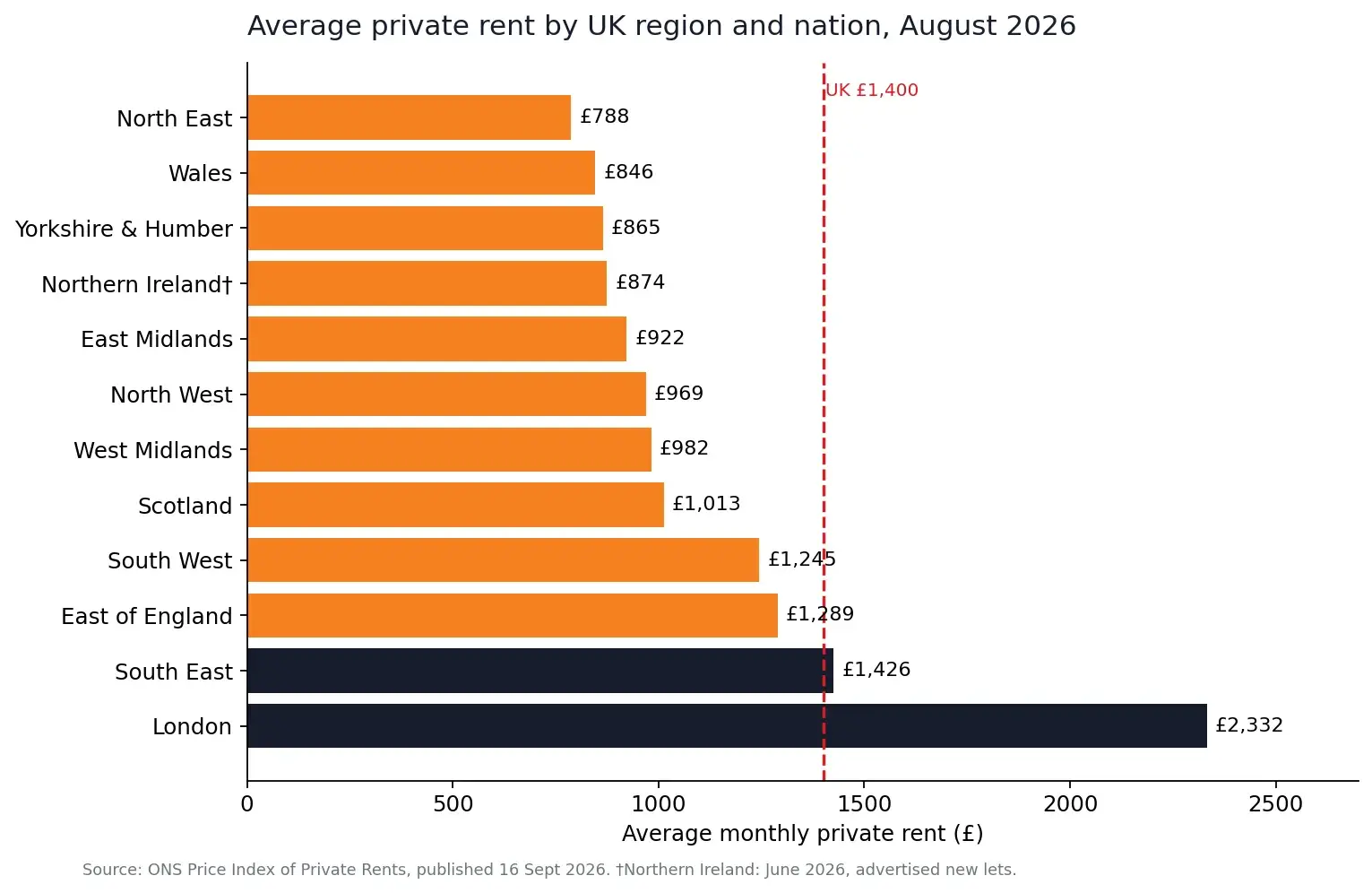
Regional averages show how far rents diverge across the country. All figures are ONS average private rents for August 2026 (Northern Ireland: June 2026).
| Region / nation | Average rent | Annual change | Cheapest area within region (ONS, July/Aug 2026) |
|---|---|---|---|
| North East | £788 | +5.8% | Hartlepool £558 |
| Yorkshire and the Humber | £865 | +4.9% | North East Lincolnshire £633 |
| East Midlands | £922 | +3.7% | East Lindsey £699 |
| North West | £969 | +5.8% | Burnley £631 |
| West Midlands | £982 | +4.9% | Stoke-on-Trent £715 |
| South West | £1,245 | +4.4% | Torridge £788, West Devon £840 |
| East of England | £1,289 | +3.5% | Fenland £840, Great Yarmouth £841 |
| South East | £1,426 | +3.0% | Isle of Wight £950, Hastings £1,007 |
| London | £2,332 | +3.5% | Bexley £1,537 |
| Wales | £846 | +4.3% | Powys £622 |
| Scotland | £1,013 | +1.1% | Dumfries and Galloway £558 |
| Northern Ireland | £874 | +1.6% | Regional BRMA data available from ONS; not analysed here |
| UK | £1,400 | +3.8% |
Source: ONS Private rent and house prices, UK: September 2026; ONS PIPR local authority tables July and August 2026.
Every English region north of the Midlands has an average rent below £1,000. Every region from the South West downwards is above £1,200. The gap between the cheapest local area (£558) and the most expensive (Kensington and Chelsea, £3,690) is more than six-fold.
Wales is the cheapest UK nation on the ONS measure at £846, though Cardiff (£1,177) is priced closer to English cities. Scotland's national average of £1,013 is pulled up by Edinburgh and Glasgow; the ONS notes that Scottish data has historically been weighted towards advertised new lets, so treat comparisons with caution.
Cheapest Places to Rent a 1-Bedroom Property
Direct answer: The cheapest one-bedroom rentals in the UK are in Hartlepool, where the ONS average was £401 a month in August 2026. Burnley (£465), Rotherham (£488), Doncaster (£493), Darlington (£496) and Middlesbrough (£499) all averaged under £500. The UK average for a one-bedroom property was £1,136.
One-bedroom homes are the cheapest property type everywhere, but the geographic gap is enormous. A one-bed in London averaged £1,760 in August 2026, more than four times Hartlepool's figure. In Manchester it was £1,003, in Leeds £782, in Liverpool £686 and in Sheffield £690.
Two practical points for one-bed renters:
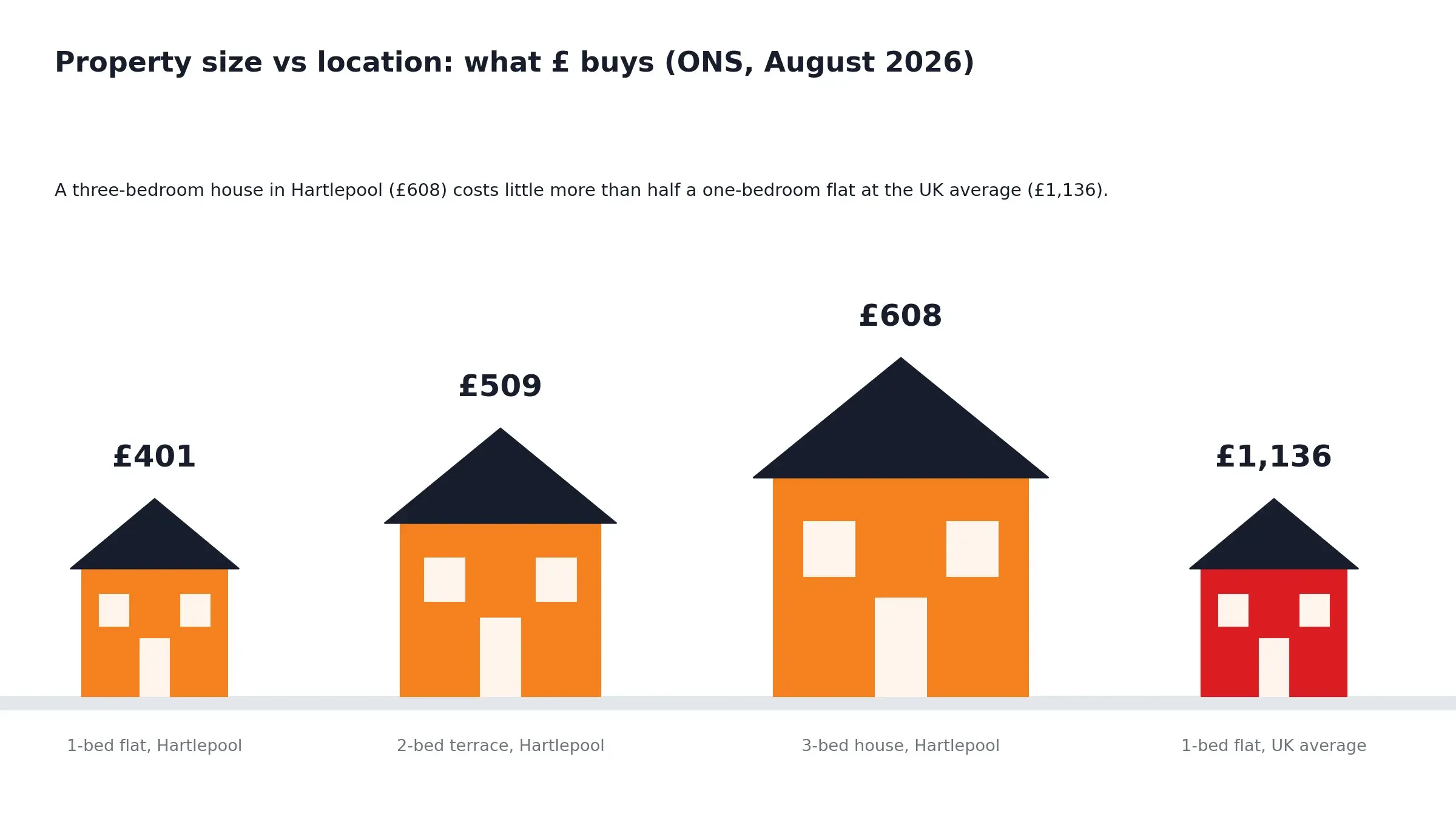
- In many cheap northern towns, one-bedroom flats are scarce because the housing stock is dominated by two- and three-bedroom terraces. A two-bed terrace at £509 in Hartlepool or £588 in Burnley may be easier to find than a one-bed and costs little more.
- Room rentals in shared houses are cheaper still. SpareRoom's Q2 2026 data puts the UK average room rent at £761 a month, with the North East at £552.
Cheapest Places to Rent a 2-Bedroom Property
Direct answer: The cheapest two-bedroom rentals in the UK are in Hartlepool (£509 a month, ONS, August 2026), followed by Burnley (£588), Rotherham (£615), Darlington (£629), Barnsley (£630), Middlesbrough (£634) and Doncaster (£636). Two-bedroom homes in London averaged £2,232.
Two-bedroom homes are the most common rental property type in the UK and the sharpest test of affordability for couples, sharers and small families. The table shows how far £650 a month goes in different places:
| Location | 2-bed average (Aug 2026) |
|---|---|
| Hartlepool | £509 |
| Burnley | £588 |
| Sunderland | £647 |
| Blackpool | £652 |
| Stoke-on-Trent | £662 |
| Bradford | £675 |
| Wigan | £700 |
| Liverpool | £837 |
| Sheffield | £840 |
| Leeds | £975 |
| Birmingham | £1,003 |
| Manchester | £1,233 |
| Bristol (July 2026, all types) | £1,880 |
| London (regional average) | £2,232 |
Source: ONS Price Index of Private Rents, August 2026.
Cheapest Places to Rent for Families
Families usually need three or more bedrooms, and this is where the North–South gap widens most. The ONS UK average for a four-or-more-bedroom home was £2,080 in August 2026, but three-bedroom homes in the cheapest areas cost a third of that.
Cheapest three-bedroom averages (ONS, August 2026): Hartlepool £608, Burnley £696, Rotherham £743, Barnsley £753, Middlesbrough £754, Doncaster £757, Darlington £766, Sunderland £773, Blackpool £794, Stoke-on-Trent £796, Bradford £808. In London a three-bed averaged £2,643.
Beyond rent, family renters should weigh:
- Schools. Check Ofsted reports (England), Estyn (Wales) or Education Scotland for the specific catchment, not the town as a whole. Cheap towns have a mix of good and struggling schools like anywhere else.
- Space. Three-bed terraces in Lancashire and Teesside are typically 80–95 square metres with small yards; three-bed semis on 1930s–70s estates in places like Doncaster, Wakefield and County Durham usually have gardens and off-street parking.
- Council tax. Larger homes sit in higher bands. Band D charges vary by several hundred pounds a year between councils, so check the specific council's 2026–27 rates.
- Transport. Families often need two commutes plus school runs. A cheap town with one working adult commuting an hour each way can cost more in time and fares than a slightly dearer suburb.
- Employment. Teesside, Humberside and east Lancashire have lower average wages than the big cities. If your work is remote or you have a job lined up locally, that matters less.
The data does not support a single "best" family location. It does show that a three-bedroom home in the cheapest 20 or so local authorities in England costs under £800 a month, against a national average for three-beds well above £1,200.
Cheapest Places to Rent Near Major UK Cities
Renting just outside a major city rather than in it is the most common way to cut rent without changing jobs. All figures are ONS averages for August 2026 unless marked July.
Near London
The cheapest London boroughs are Bexley (£1,537), Sutton (£1,556), Havering (£1,565) and Hillingdon (£1,570). Outside the boundary, Luton (£1,222), Medway (£1,236, July), Southend-on-Sea (£1,306), Thurrock (£1,375, July) and Basildon (£1,424) are cheaper than any borough. Further out, Peterborough (£1,012), Northampton (West Northamptonshire, £1,078, July), Milton Keynes (£1,344) and Ashford (£1,248) have fast rail links. Peterborough to King's Cross takes under 50 minutes on the fastest services (around an hour on most); Doncaster (£694) is roughly an hour and a half. Season-ticket costs for these routes run to several thousand pounds a year, so calculate the full figure before assuming a saving.
Near Manchester (£1,373)
Wigan (£746), Rochdale (£855), Bolton (£894), Tameside (£927, July), Oldham (£942) and Bury (£969) are all on the Metrolink or Northern rail network with journeys of 20–40 minutes into the city centre. Burnley (£631) is around 55 minutes by rail.
Near Birmingham (£1,099)
Dudley (£858), Walsall (£924), Wolverhampton (£945) and Sandwell (£947, July) are all cheaper and linked by the West Midlands Metro or rail. Stoke-on-Trent (£715) is 45–50 minutes by train.
Near Leeds (£1,145)
Bradford (£745), Kirklees (£780, July), Wakefield (£806) and Barnsley (£696) are all within 20–40 minutes by rail. Doncaster (£694) is around 35 minutes.
Near Liverpool (£913)
Halton (£745, July), St Helens (£802, July), Knowsley (£844, July) and Wirral (£852, July) are cheaper than the city itself, and Liverpool is already the cheapest of England's core cities.
Near Bristol (£1,880, July)
Bristol is the most expensive major city outside London on the ONS measure. North Somerset (£1,205, July), South Gloucestershire (£1,456, July) and Newport in South Wales (£959) all offer sizeable savings; Newport to Bristol Temple Meads takes around 35 minutes by train.
The trade-off: every pound saved on rent has to be set against fares, journey time and the cost of running a car if public transport is poor. A £300 monthly rent saving can disappear into a £250 rail season ticket and two hours a day of travel.
Cheapest Places to Rent Compared With London
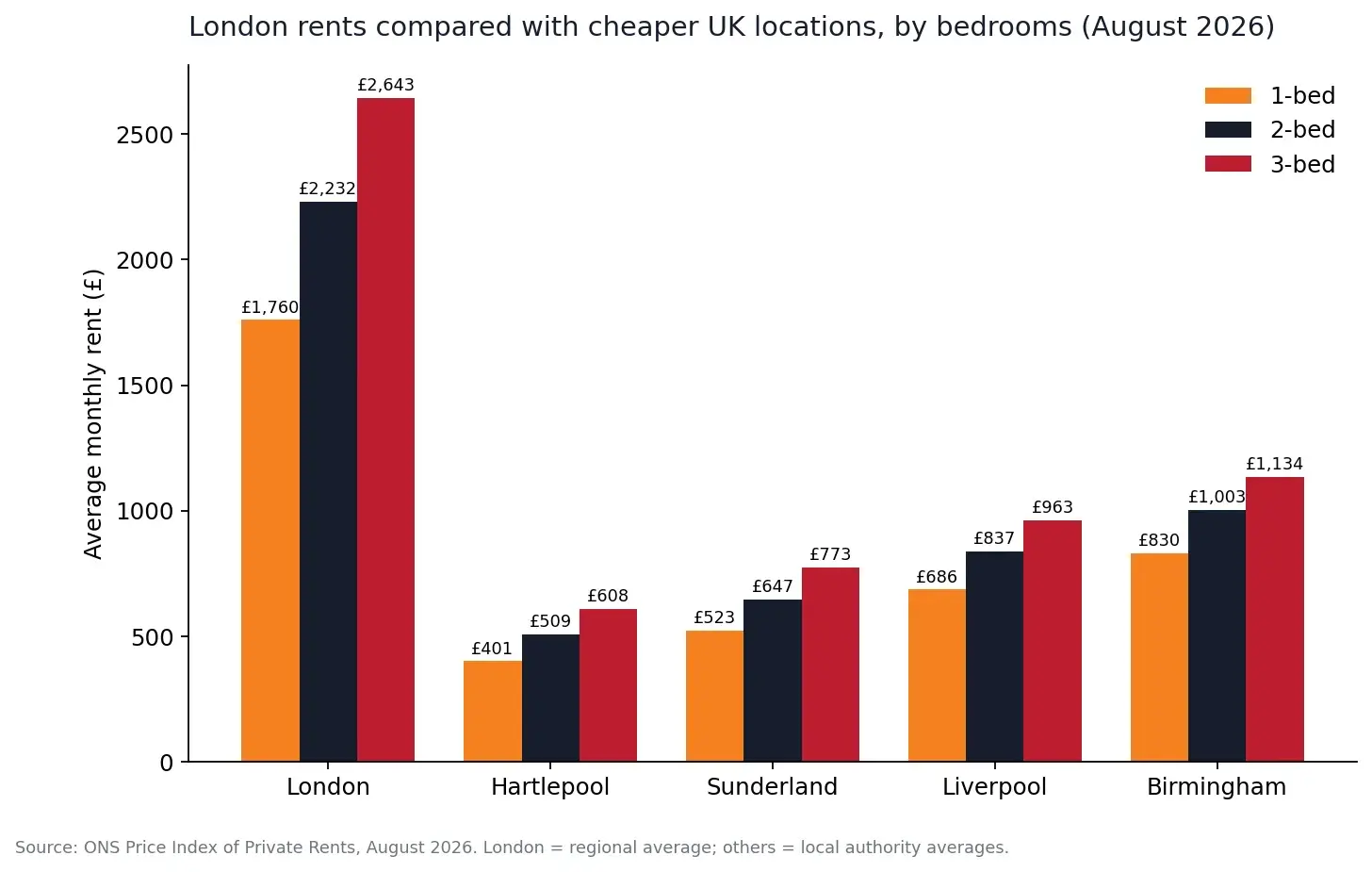
London's average private rent of £2,332 in August 2026 is nearly three times the North East average of £788, and more than four times Hartlepool's £558. Asking rents for new lets are higher still: Rightmove recorded an average advertised rent of £2,791 in London in Q2 2026, against £1,397 outside the capital.
| London (ONS, Aug 2026) | Hartlepool | Sunderland | Liverpool | Birmingham | |
|---|---|---|---|---|---|
| All property types | £2,332 | £558 | £707 | £913 | £1,099 |
| 1-bed | £1,760 | £401 | £523 | £686 | £830 |
| 2-bed | £2,232 | £509 | £647 | £837 | £1,003 |
| 3-bed | £2,643 | £608 | £773 | £963 | £1,134 |
Source: ONS Price Index of Private Rents, August 2026.
The size difference matters as much as the price. A London one-bedroom flat at £1,760 costs almost three times a three-bedroom house in Hartlepool (£608). For someone able to work remotely or in a nationally mobile profession (NHS, teaching, civil service, logistics), the rent difference alone can amount to £15,000–£20,000 a year.
What London offers in return is the country's deepest job market, higher average wages, dense public transport and the ability to live without a car. Someone leaving a London salary for a regional one may find their income falls alongside their rent. Lifestyle is a personal call; the rent arithmetic is not.
Is Moving to a Cheaper Area Actually Worth It?
It depends on whether the rent saving survives contact with everything else that changes. Run through each item:
- Rent saving: Compare like-for-like property types, not headline averages. Use the bedroom-level ONS figures above and then check live listings.
- Transport: If you keep your job, cost the commute at 2026 fares. If you drive, add fuel, insurance, parking and depreciation.
- Commute time: Two hours a day is roughly 460 hours a year. Put a value on that.
- Council tax: Similar-sized homes sit in different bands and different councils charge different rates. Check the property's band on GOV.UK (England and Wales) or the Scottish Assessors website and the council's 2026–27 charge.
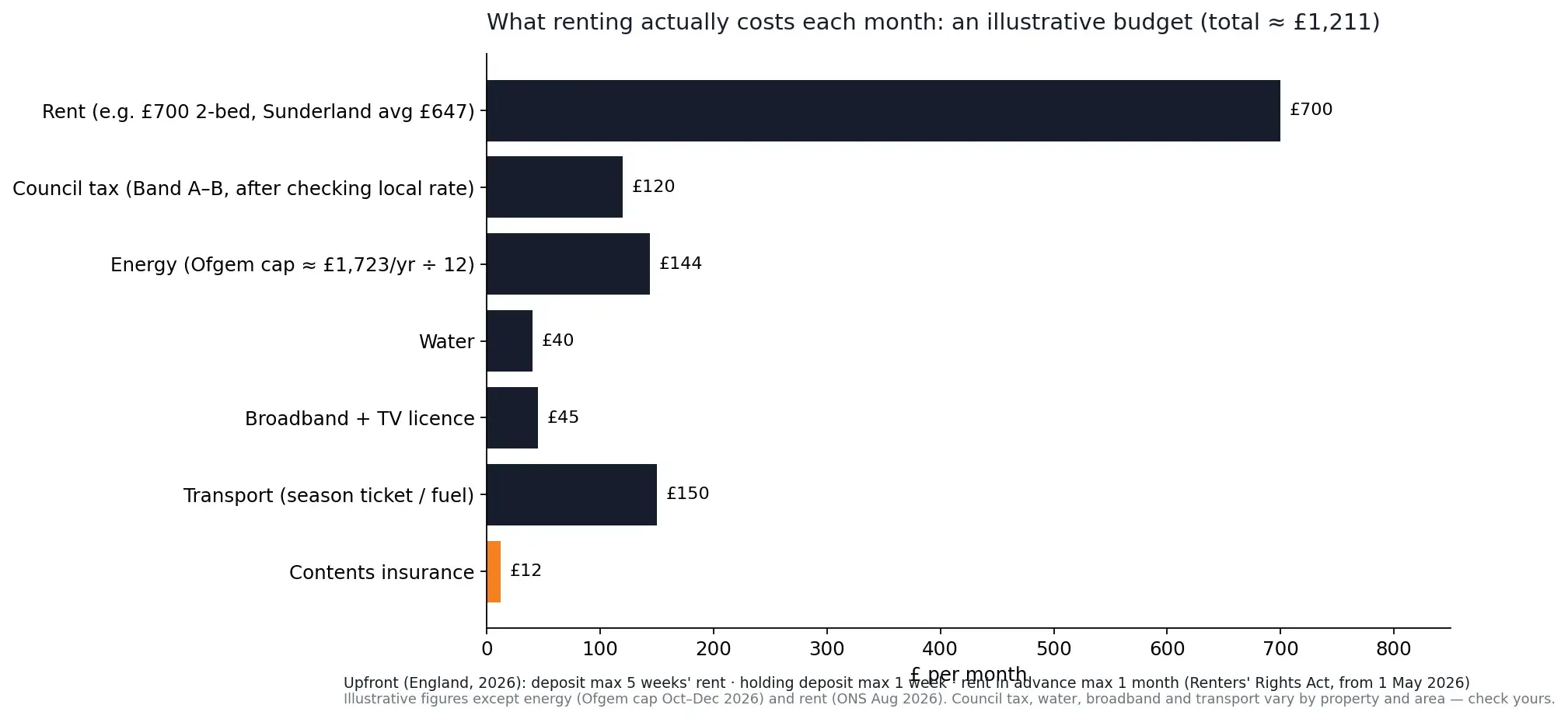
- Energy: Ofgem's price cap for 1 October–31 December 2026 is £1,723 a year for a typical dual-fuel household paying by Direct Debit in Great Britain, about £144 a month. Older terraces in cheap areas are often poorly insulated; check the EPC rating on the listing.
- Employment: Look up job listings and average pay in the new area before you move, not after.
- Amenities and services: GP registration, childcare availability and broadband speeds vary by area.
- Lifestyle: Friends, family, hobbies and how you spend weekends all have a cost or a value.
A simple way to decide: write down your current total monthly outgoings (rent, council tax, energy, transport, other bills), do the same for the new area using real listings and real fares, and compare the totals rather than the rents. Nobody else can make this decision for you, but the comparison is only meaningful when it covers everything.
How Much Rent Can You Afford?
Direct answer: Many UK letting agents reference tenants against an annual income of around 30 times the monthly rent (equivalent to rent being roughly 40% of gross income), and many budgeting guides suggest keeping rent at or below 30–35% of take-home pay. Neither is a rule. What you can afford is what is left after every other essential cost is paid.
Work through the full monthly picture:
| Cost | What to check |
|---|---|
| Rent | Advertised rent on current listings, not the area average |
| Council tax | Band and 2026–27 charge for the specific property; single-person discount is 25% |
| Energy | Ofgem cap is a guide (£1,723/year typical); larger or poorly insulated homes cost more |
| Water | Fixed or metered; varies by supplier |
| Broadband and TV licence | Typically £25–£60 a month combined |
| Transport | Season ticket or fuel, insurance, parking |
| Contents insurance | Landlord's insurance does not cover your belongings |
| Food, childcare, debt repayments | Your own figures |
Upfront costs in England (2026):
- Tenancy deposit: capped at five weeks' rent where annual rent is under £50,000 (Tenant Fees Act 2019). On an £800 rent that is £923. Must be protected in a government-approved scheme.
- Holding deposit: capped at one week's rent and must be returned or deducted from your first payment.
- Rent in advance: since 1 May 2026 under the Renters' Rights Act, landlords in England cannot ask for more than one month's rent in advance, cannot take rent before the agreement is signed, and cannot accept offers above the advertised rent. Rents can generally be increased only once a year with at least two months' notice.
- Moving costs: van hire or removals, plus any overlap between tenancies.
Rules differ in Wales, Scotland (where deposits are capped at two months' rent) and Northern Ireland. Proptino's guide to the Renters' Rights reforms covers the England changes in more detail.
How to Find Cheap Rental Properties in the UK
- Compare locations with the same data. Use the ONS local-authority and bedroom figures in this guide to shortlist areas, then confirm with live listings. Do not compare an ONS average in one town with an asking rent in another.
- Compare property types. In many northern towns a two-bed terrace costs barely more than a one-bed flat. Decide whether you want space or a smaller bill.
- Search several platforms. Portals, agent websites and direct-let platforms carry different stock. Set alerts on each.
- Use realistic filters. Set your maximum rent slightly above your target so you see properties that may be negotiable, and filter by bedrooms and furnished/unfurnished.
- Look at neighbouring authorities. The tables above show that crossing a council boundary can cut rent by £150–£400 a month within the same commuter belt.
- Cost the commute properly. Check season-ticket prices or fuel and parking before you fall for a low rent.
- Total everything. Rent + council tax + energy + water + broadband + transport. Compare totals between areas, not rents.
- Move fast on good listings. Rightmove reported an average of 10 enquiries per rental listing in Q2 2026, and 14 in the North West. Have references, ID and proof of income ready before you view.
- Verify who you are dealing with. Check the agent's redress-scheme membership (Property Ombudsman or Property Redress Scheme), never pay a deposit before viewing, and confirm the deposit will be protected.
- Read the tenancy agreement before paying anything. Check the rent, the deposit amount, who pays which bills, the notice terms and any clauses on pets or decoration. Take a viewing checklist with you so nothing is missed.

Ready to compare rental options? Search Proptino for properties that match your preferred location, property type and budget.
Frequently Asked Questions
What is the cheapest place to rent in the UK?
Hartlepool in the North East of England and Dumfries and Galloway in Scotland are the cheapest local areas, both with an ONS average private rent of £558 a month in August 2026. Burnley (£631) is the next cheapest in England.
What are the cheapest cities to rent in the UK?
Among larger towns and cities, Sunderland (£707), Middlesbrough (£698), Hull (£691), Doncaster (£694), Barnsley (£696) and Rotherham (£686) had the lowest ONS average rents in mid-2026. Liverpool (£913) is the cheapest of England's core cities.
Which UK region has the lowest rent?
The North East of England, with an ONS average of £788 a month in August 2026. Wales (£846) is the cheapest UK nation. London is the most expensive region at £2,332.
Where is the cheapest place to live in the UK?
Lowest rent and lowest overall cost of living are not the same thing. The cheapest rents are in the North East, east Lancashire, the Humber and rural Wales and Scotland, but council tax, energy, transport and local wages all affect the total. Compare full monthly budgets rather than rent alone.
Is it cheaper to rent in northern England?
Yes. Every English region north of the Midlands had an average rent below £1,000 in August 2026, while every southern region was above £1,200. Northern rents are rising faster, however, at up to 5.8% a year.
What is the cheapest UK city for families?
Three-bedroom homes averaged under £800 a month in Hartlepool, Burnley, Rotherham, Barnsley, Middlesbrough, Doncaster, Sunderland, Blackpool, Stoke-on-Trent and Bradford in August 2026. Which is best depends on schools, jobs and transport for your household.
Where can I rent cheaply near London?
Bexley, Sutton and Havering are the cheapest boroughs (£1,537–£1,565). Luton, Medway, Southend, Thurrock and Basildon are cheaper still, and Peterborough (£1,012) has a sub-50-minute fastest link to King's Cross.
How much rent can I afford?
There is no universal rule. Agents commonly reference against annual income of about 30 times the monthly rent; many budgeting guides suggest 30–35% of take-home pay. Add council tax, energy, transport and other essentials to see what is actually left.
Is moving to a cheaper city worth it?
Only if the rent saving survives after adding commuting costs and time, council tax, energy and any change in income. Compare total monthly costs, not rents.
Find Affordable Rental Properties with Proptino
Proptino is a property marketplace where landlords, letting agents and private sellers advertise homes for sale and to rent, in the UK and overseas. Rental listings in the UK can be filtered by location, property category (flat, house, studio, room, maisonette and more), number of bedrooms, price range and amenities such as parking, garden or pets allowed.
For renters using this guide, that means you can take a shortlist of affordable areas from the tables above and check what is actually available in each one at your budget, side by side. Listings show the asking rent, so you can set them against the ONS averages here to see whether a property is priced above or below the local norm.
Landlords and agents can advertise a property for free, and Proptino also offers tenant referencing and rent insurance services. Renters can find estate and letting agents in the UK by area through the agent directory.
Find Your Next Rental Property with Proptino
Explore rental properties across the UK, compare locations and find listings that fit your needs and budget.
Conclusion
In 2026 the cheapest places to rent in the UK are Hartlepool and Dumfries and Galloway at £558 a month, followed by a cluster of towns across the North East, east Lancashire, the Humber and the South Wales valleys, all under £700. The North East is the cheapest English region at £788, Wales the cheapest nation at £846, and London the most expensive area at £2,332. A three-bedroom home in the cheapest areas costs less than a one-bedroom flat in most of the South. Whether a move pays off depends on the total monthly cost, including commuting, council tax and energy, and on what happens to your income. The ONS figures give you a fair basis for comparing areas; live listings tell you what you will actually pay.