

Cheapest Places to Buy a House in the UK

On the most comparable measure — the average sold price for all property types across a whole council area — the cheapest place to buy a house in the UK in July 2026 was Inverclyde, in Scotland, at £115,401. In England, the cheapest council area was Burnley, at £135,012. The cheapest city was Aberdeen, at £130,689, and the cheapest English city was Kingston upon Hull, at £135,511.
That answer needs a warning before you act on it. A council area is not a town, and an average is not a price tag on a particular home. Inverclyde includes Greenock and Port Glasgow as well as smaller settlements; Burnley's figure covers every sale in the borough, from flats to detached houses. Averages also hide the property type: in Burnley, flats averaged £81,075 while terraced houses averaged £115,123 in the same month. If you want a house rather than a flat, use the terraced column, not the headline average.
This guide keeps those measures separate throughout. It starts with the council-area ranking, then gives the city ranking, then the much lower postcode-district figures — and explains why those postcode figures are not a better answer, just a narrower one. Prices are from the UK House Price Index (UK HPI) for July 2026, as reported by Property Investments UK on 28 September 2026, unless another source and period are stated. July 2026 figures are provisional and will be revised as more sales are registered. Northern Ireland figures in that comparison cover April to June 2026, because Northern Ireland council figures are quarterly.
For context, the UK average house price was £273,037 in August 2026 on the UK HPI (provisional), up 0.9% on a year earlier. England averaged £293,525, Scotland £198,397, Wales £216,363, and Northern Ireland £202,487 in the second quarter of 2026. The cheapest council areas below are therefore roughly half the UK average — and, in Inverclyde's case, less than half.
The data behind this guide
Five different price measures appear in this guide, and they are not interchangeable. Mixing them as if they were one ranking is the main error in weaker guides — including older ones that still name Burnley as the cheapest place in the UK on November 2024 figures.
| Measure | Publisher | What it counts | Figure used in this guide |
|---|---|---|---|
| Average sold price (council area) | UK House Price Index / HM Land Registry | Completed sales across a whole local authority, all property types | July 2026 (Northern Ireland: Apr–Jun 2026) |
| Average asking price (postcode district) | Property Investments UK analysis | Advertised prices in one postcode district — what sellers hope for, not what buyers paid | September 2026, Great Britain |
| Median sold price (postcode district) | UK HPI price-paid data | The middle completed sale in a district; districts with 30+ sales only | May 2025 – April 2026 |
| First-time-buyer average price | UK House Price Index | Completed sales to first-time buyers, who typically buy smaller, cheaper homes | July 2026 |
| House price to earnings ratio | Nationwide; Lloyds / Bank of Scotland | Typical price divided by typical local earnings — affordability, not price alone | 2025 (Nationwide) and 2026 (Lloyds) releases |
Limitations to keep in mind: July 2026 UK HPI figures are provisional and will be revised. Council areas are not towns, so a named area is noted as a council area rather than a street-level location. Local monthly values can be volatile where transactions are few — recorded trends matter more than one month's change.
Where Is the Cheapest Place to Buy a House in the UK?
Inverclyde, at £115,401, was the cheapest of 360 UK council areas in July 2026. West Dunbartonshire was second at £127,521, and the City of Aberdeen third at £130,689 — so the three cheapest council areas in the UK were all in Scotland. Burnley, fourth overall, was the cheapest in England.
Older guides still name Burnley as the cheapest place in the UK. That was true on the November 2024 figures used by HomeOwners Alliance (£117,636 for Burnley). It is no longer true on July 2026 sold prices, and this guide does not repeat the older ranking as if it were current. Prices move, and a guide that does not say when its prices are from is not a guide you should budget from.
There is a second, different "cheapest" that search results often show first. On average asking prices in September 2026, Bradford city centre's BD1 postcode district averaged £67,397 — the lowest of 2,488 postcode districts in Great Britain with an asking price. That is a useful signal that very low-priced homes exist, but it is not the same purchase as a home in Inverclyde. BD1's sales are dominated by flats, its geography is a single city-centre district, and an asking price is what sellers hope for, not what buyers paid. Use postcode figures to shortlist streets to investigate, not to declare a national winner.

Cheapest Places to Buy a House in the UK — The Evidence-Based Comparison
| Rank | Council area | Nation / region | All property types | Flats | Terraced houses |
|---|---|---|---|---|---|
| 1 | Inverclyde | Scotland | £115,401 | £87,280 | £131,504 |
| 2 | West Dunbartonshire | Scotland | £127,521 | £94,082 | £146,029 |
| 3 | City of Aberdeen | Scotland | £130,689 | £92,897 | £145,174 |
| 4 | Burnley | North West, England | £135,012 | £81,075 | £115,123 |
| 5 | City of Kingston upon Hull | Yorkshire and the Humber | £135,511 | £78,654 | £125,272 |
| 6 | Hartlepool | North East, England | £136,894 | £76,394 | £107,343 |
| 7 | Blackpool | North West, England | £137,386 | £75,951 | £120,578 |
| 8 | East Ayrshire | Scotland | £138,971 | £77,665 | £121,633 |
| 9 | Na h-Eileanan Siar (Western Isles) | Scotland | £139,518 | £68,963 | £89,218 |
| 10 | County Durham | North East, England | £140,447 | £78,510 | £116,586 |
Source: UK HPI via Property Investments UK, updated 28 September 2026. Provisional figures.
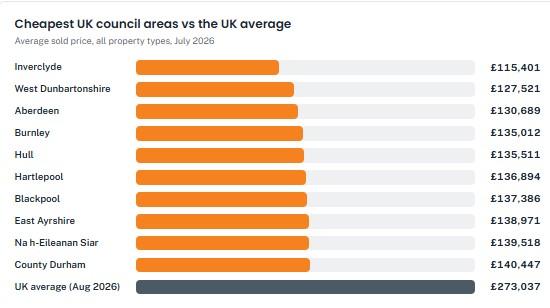
Source: UK House Price Index via Property Investments UK, July 2026; UK average from UK HPI August 2026 (provisional).
Three patterns matter more than any single rank. First, Scotland and the north of England dominate: of the 20 cheapest council areas, 12 were in England, seven in Scotland and one in Wales, and none in Northern Ireland. Second, the gaps at the top are small — Burnley was only £499 below Hull — so a single month's revisions could reorder places 4 to 7. Treat the top ten as a shortlist, not a league table to bet a move on. Third, flats are what pull many averages down. In all 20 of England's cheapest council areas, the average flat was under £100,000 in July 2026, but no average terraced house in those areas got that low. Hartlepool had the cheapest terraced average among England's cheapest areas, at £107,343.
Looking for an affordable property?
Explore homes for sale on Proptino and compare properties by location, property type and budget.
| Cheapest council area | Region / nation | All property types |
|---|---|---|
| Inverclyde | Scotland | £115,401 |
| Burnley | North West | £135,012 |
| City of Kingston upon Hull | Yorkshire and the Humber | £135,511 |
| Hartlepool | North East | £136,894 |
| Blaenau Gwent | Wales | £144,294 |
| Stoke-on-Trent | West Midlands | £147,377 |
| Boston | East Midlands | £177,438 |
| Mid and East Antrim | Northern Ireland | £177,450 |
| Great Yarmouth | East of England | £209,114 |
| Torbay | South West | £222,118 |
| Southampton | South East | £235,977 |
| Barking and Dagenham | London | £375,604 |
Source: UK HPI via Property Investments UK, July 2026 (Northern Ireland: April–June 2026).
The cheapest English region overall was the North East, at £166,943 in July 2026, against £293,479 for England as a whole. That does not mean every North East town is cheap, and it does not make Burnley — in the North West — any less cheap because its region is dearer on average. Regional averages include expensive suburbs and rural areas alongside the cheapest boroughs.
If you cannot move to Scotland or the north, the south has its own floor, and it is much higher. Torbay was the cheapest council area in the South West at £222,118, Plymouth next at £223,161, and Southampton the cheapest in the South East at £235,977. Great Yarmouth, in the East of England, averaged £209,114 — less than any southern council area. Even London's cheapest borough, Barking and Dagenham at £375,604, averaged more than the East of England as a whole.
Where the cheapest areas cluster

Schematic by nation and region — average sold price, July 2026 (Northern Ireland: April–June 2026). Not to geographic scale.
Cheapest Places to Buy a House in England
Burnley (£135,012), Hull (£135,511) and Hartlepool (£136,894) were within £1,882 of each other in July 2026. Blackpool (£137,386) and County Durham (£140,447) completed England's top five, followed by Middlesbrough (£140,909), Hyndburn (£141,430), Sunderland (£147,114), Stoke-on-Trent (£147,377) and North East Lincolnshire (£147,727).
Nineteen of England's 20 cheapest council areas were in the North East, the North West, or Yorkshire and the Humber. Stoke-on-Trent was the only exception, as the West Midlands' cheapest area. That concentration is the single most important fact for anyone searching from the south: the cheapest English markets are not scattered evenly around the country, and a "cheap" move usually means a northern move, a change of job market, or a longer commute.
It is also worth noting what rose and what did not. Over the year to July 2026, Burnley rose 8.6%, Hyndburn 8.5% and Pendle 8.3%, while England as a whole rose 1.1%. Only Stoke-on-Trent, among England's 20 cheapest, was lower on the year, by 0.8%. Cheap does not mean falling, and a low price today is not evidence that a home will stay low-priced. The City of Aberdeen, for comparison, fell 8.7% over the same year — a reminder to check the direction of a local market, not just its level.
Cheapest Places to Buy a House in Scotland
Scotland's cheapest council area was Inverclyde (£115,401), followed by West Dunbartonshire (£127,521), the City of Aberdeen (£130,689), East Ayrshire (£138,971) and Na h-Eileanan Siar (£139,518). Scotland's average in August 2026 was £198,397 — below every English region except the North East — so the pattern is broader than a few outliers.
Two cautions apply. First, council areas in Scotland can be large and varied: the City of Aberdeen figure is a city average, while Na h-Eileanan Siar covers the Western Isles, where the terraced average (£89,218) was far below the all-property average (£139,518) because larger or detached sales pull the headline up. If you are buying a terraced house there, the terraced figure is the relevant one. Second, Scotland's buying system differs from England's: offers, Home Reports and the LBTT system (see the first-time-buyer section) work differently, so budget for Scottish conveyancing advice specifically rather than assuming an English process.
Cheapest Places to Buy a House in Wales
Blaenau Gwent was Wales's cheapest council area in July 2026, at £144,294 — 14th cheapest in the UK overall and the only Welsh area in the UK top 20. Wales averaged £216,363 in August 2026, up 3.1% on a year earlier.
Raw price is only half the Welsh story. On Nationwide's 2025 first-time-buyer house-price-to-earnings analysis, Merthyr Tydfil was Wales's most affordable area, at 3.3 times local earnings. That is a different measure from the sold-price ranking above — it divides a first-time-buyer price by local earnings — so Merthyr Tydfil's presence here does not contradict Blaenau Gwent's position on sold prices. It does show why a buyer should check both: the cheapest place to buy is not always the place where a local salary stretches furthest, and vice versa. Wales has no first-time-buyer tax relief of its own (see below); its standard Land Transaction Tax threshold is £225,000, which is already higher than England's standard £125,000 threshold.
Cheapest Places to Buy a House in Northern Ireland
Northern Ireland's cheapest council area on the available quarterly figures was Mid and East Antrim, at £177,450 for April to June 2026. Belfast averaged £184,768 over the same quarter. Northern Ireland's overall average rose to £202,487 in the second quarter of 2026, up 9.2% on a year earlier — the fastest annual rise of any UK nation in the August 2026 UK HPI release.
That combination — the highest average in the "cheapest four" nations, but the fastest growth — is why Northern Ireland appears in no UK top 20 on council-area sold prices, yet still looks affordable against England and London. Buyers should also note the timing lag: because Northern Ireland council figures are quarterly, a July 2026 UK ranking will always compare a spring quarter in Northern Ireland with a July month elsewhere. Do not treat a £177,450 quarterly figure and a £135,012 monthly figure as if they were recorded on the same day.
Cheapest Cities to Buy a House in the UK
Many buyers search for a city, not a council area. On the GOV.UK list of cities, taking each city's council-area figure, the cheapest ranked city in July 2026 was Aberdeen.
| Rank | City | Nation | All property types | Flats |
|---|---|---|---|---|
| 1 | Aberdeen | Scotland | £130,689 | £92,897 |
| 2 | Kingston upon Hull | England | £135,511 | £78,654 |
| 3 | Dundee | Scotland | £146,924 | £101,496 |
| 4 | Sunderland | England | £147,114 | £81,768 |
| 5 | Stoke-on-Trent | England | £147,377 | £89,184 |
| 6 | Doncaster | England | £172,305 | £89,652 |
| 7 | Bradford | England | £182,766 | £108,466 |
| 8 | Belfast | Northern Ireland | £184,768 | Not enough data |
| 9 | Lincoln | England | £187,079 | £107,135 |
| 10 | Preston | England | £188,629 | £100,224 |
Source: UK HPI via Property Investments UK, July 2026. Only 54 of the 76 GOV.UK cities could be ranked this way; London is excluded because its same-name council area is the City of London.

Aberdeen was £4,822 cheaper than Hull overall, but Hull had the cheapest flats of the 15 cheapest cities, at £78,654 against Aberdeen's £92,897. Liverpool (£189,036), Nottingham (£190,200) and Glasgow (£193,675) followed just outside the top ten, while Sheffield, Birmingham, Leeds and Manchester ranked 20th to 36th. Oxford (£471,667) and Cambridge (£475,151) were among the dearest. Only 54 of the 76 GOV.UK cities could be ranked this way, because some cities — Durham and Carlisle among them — have no council area of their own name.
How Much Does a House Cost in the Cheapest UK Locations?
Averages by property type show why the headline figure can mislead. Across the UK in August 2026, detached homes averaged £443,846, semi-detached £278,675, terraced £232,505 and flats £194,148. In England, the same month's figures were detached £472,671, semi-detached £291,962, terraced £247,371 and flats £218,563. A buyer who wants a detached house in even the cheapest council area should not budget from an all-property average that includes flats.
Property type matters more than location alone

£194,148Flat / maisonette£232,505Terraced£278,675Semi-detached£443,846Detached
A flat anywhere in the UK costs less on average than a terraced house in most areas — compare like with like before comparing places.

The postcode evidence sharpens the point. On asking prices in September 2026, eight English postcode districts averaged under £100,000: Bradford BD1 (£67,397), Shildon DL4 (£76,093), Grimsby DN31 (£81,157), Sunderland SR1 (£83,244), Middlesbrough TS1 (£83,577), Peterlee SR8 (£96,467), Hull HU2 (£97,392) and Middlesbrough TS3 (£97,683). On median sold prices for sales completed between May 2025 and April 2026 (districts with 30 or more sales), Sunderland SR1 was lowest at £54,975 — but from only 30 sales, 19 of them flats. Peterlee SR8 is the more useful example: 433 sales, 270 of them under £100,000, and nearly all of those were houses (240 terraced, 115 semi-detached and 73 detached sales in total, only five flats). A district where low prices are mostly houses is a different prospect from a city-centre district where low prices are mostly flats.
About one home in 30 sold in the English postcode districts counted between May 2025 and April 2026 went for under £100,000 (22,163 of 653,545 sales). In the North East it was about one in six; in London about one in 600. That is the honest scale of the "under £100,000 house" search: real, concentrated in the North East and Yorkshire and the Humber, and rare elsewhere.
Check what a home is really worth
Get a free instant online valuation based on nearby sold prices — a starting point before you view, not a guaranteed price.
What Makes a Place Affordable for Homebuyers?
A low price is not the same as affordability. Affordability compares price with what people in or moving to an area can actually pay, plus the ongoing cost of living there. The standard shorthand is the house-price-to-earnings ratio: the typical house price divided by typical earnings. A lower ratio means a home costs fewer years of pay.
On Nationwide's 2025 first-time-buyer analysis, Inverclyde was Great Britain's most affordable local authority, at 2.3 times local earnings for a typical first-time-buyer home, followed by Burnley at 2.8, Hartlepool at 2.9, Kingston upon Hull at 3.0, Merthyr Tydfil at 3.3 and Stoke-on-Trent at 3.4. On Lloyds / Bank of Scotland's broader 2026 affordability release, which uses all-buyer prices, Inverclyde and Aberdeen were joint most affordable at 3.5 times earnings, followed by Hull and Blackpool at 3.6. The two sets of numbers differ because they measure different buyers and different years — do not average them together.
Use this checklist before treating a low price as a good move:
- Jobs and income. Is your work in the area, portable, or dependent on a single large employer? A low ratio driven by low prices is different from one driven by strong local pay.
- Transport and commuting. Check the real door-to-door time and fare for the journeys you will actually make, not the distance on a map. Commuter-town analysis in September 2026 put Birkenhead's average home at £148,911 as the lowest among 66 commuter towns — useful only if Birkenhead serves the city you need.
- Council tax, energy and maintenance. Older terraced stock — common in the cheapest areas — can carry higher heating and repair bills. Check the EPC rating and the council tax band for the specific home, not the area average.
- Schools, healthcare and amenities. These do not appear in a price table. Visit at different times of day, and check catchment and service availability for your household's needs.
- Resale and rental depth. A place with few sales can be hard to value and hard to sell. Peterlee SR8's 433 sales are more reassuring than a district ranked on 30 sales.
- Total monthly cost, not just price. Mortgage payments, tax, insurance, bills and commuting together decide whether a "cheap" home is affordable month to month.
Cheap to buy does not automatically mean cheap to live in, and it does not automatically mean a good investment. Rental yield — annual rent divided by price — can look high where prices are low, but only if the home lets reliably, at the assumed rent, with voids and maintenance allowed for. This guide does not publish yield figures for these areas, because the inspected sources did not provide a single comparable yield series for all of them.
A useful explainer of the years-of-pay idea: the independent video "Cheapest Places to Live in the UK (Ranked by Years of Pay)" uses ONS house-price-to-earnings data for England and Wales (2025). It is an independent creator's video, not an official source, and no price in this guide comes from it.
Cheapest Places to Buy a House for First-Time Buyers
First-time buyers face a different price distribution from all buyers, because they typically buy smaller and cheaper homes. In July 2026, first-time buyers paid least in Inverclyde, at £98,662 — the only council area of 349 with a first-time-buyer figure under £100,000. Aberdeen (£110,389) and West Dunbartonshire (£110,826) came next. Eight of the 15 council areas where first-time buyers paid least were in Scotland.
In England, Hartlepool was cheapest for first-time buyers at £118,977, then Burnley at £121,504, County Durham at £125,124 and Middlesbrough at £126,266. England's first-time-buyer average was £245,515 — more than double Hartlepool's figure. Among ranked cities, Aberdeen was cheapest for first-time buyers, then Dundee at £126,595 and Hull at £127,859.

What the deposit could look like

Rightmove's June 2026 hotspot reporting gives the asking-price side of the same story: the Great Britain first-time-buyer asking average was £228,048, while Middlesbrough (£90,929), Grimsby (£92,031) and Kilmarnock (£92,380) were the cheapest hotspots for typical 0–2 bedroom first-time-buyer homes. Asking prices and sold prices are different measures; do not rank a Rightmove asking figure against a UK HPI sold figure.
Property tax also differs by nation, and at these price levels it can be zero — but only if you check the rules for where you are buying. In England and Northern Ireland, first-time buyers pay 0% Stamp Duty Land Tax on the first £300,000 and 5% on the portion from £300,001 to £500,000, with relief lost entirely above £500,000. That means a first-time purchase at or below £300,000 in England or Northern Ireland — which covers every area in this guide's top tables — pays no SDLT. In Scotland, first-time-buyer relief raises the Land and Buildings Transaction Tax nil-rate band to £175,000 (from £145,000), with no upper price cap on that relief. Wales has no first-time-buyer relief; its standard Land Transaction Tax threshold is £225,000. Tax rules change and individual circumstances matter, so confirm the current position on GOV.UK / Revenue Scotland / the Welsh Revenue Authority before budgeting. This guide is not tax or mortgage advice. Before you start viewing, it is also worth reading the common first-time buyer mistakes to avoid — most of them cost money precisely because they are easy to make on a first purchase.
Is It Worth Buying a House in a Cheaper UK Area?
It can be — if the move fits your work, family and long-term plans, and if you have priced the whole cost, not just the purchase price. The advantages are real: a deposit that is reachable without years of additional saving, lower monthly mortgage payments at the same borrowing level, and in some cases room to buy a house rather than a flat. The risks are equally real: fewer local job options if your circumstances change, higher maintenance or energy costs in older stock, thinner resale markets, and the cost — financial and personal — of moving away from family, schools and support networks.
A useful test is to price three scenarios for the same household: (1) buy in the cheap area and keep your current work pattern; (2) buy in the cheap area and change jobs or commute; (3) stay renting or buy smaller where you are now. If only scenario (1) works, and it depends on a job or remote arrangement that could change, the cheap price is carrying more risk than it appears to. If you would be happy living in the area even if prices stayed flat, the low price is a bonus rather than the whole case. And if staying put and renting for longer is a real option, price that side of the comparison too — Proptino's guide to the cheapest places to rent in the UK shows what renting costs in the areas where rents are lowest.
Timing matters less than readiness. Proptino's guide to when is the best time to buy a house in the UK makes the same point from the seasonal side: the best time is generally when you can afford the purchase, have suitable finance in place, and find a home that meets your needs at a fair local price. A cheap area does not remove the need for a survey (check how much a house survey costs in the UK before you budget), conveyancing checks, and a mortgage agreement in principle.
How to Find Affordable Houses for Sale in the UK
- Start from sold prices, not asking prices. Check what similar homes on the same street actually sold for on HM Land Registry's price-paid data (England and Wales) and, in Scotland, through Registers of Scotland records. Asking prices show ambition; sold prices show evidence.
- Filter by property type first. Search for terraced houses separately from flats if you want a house. A whole-area average that mixes flats and houses will mislead you in exactly the places this guide lists.
- Shortlist council areas, then streets. Use the tables above to pick two or three areas, then drill into postcode districts and individual streets. A cheap council area still contains expensive streets, and vice versa.
- Get a quick valuation check. Proptino's free instant online valuation gives an estimate from nearby sold prices. Treat it as a starting point, not a guaranteed price — it cannot see inside the home. For the full method — what a valuation is based on and when a formal one is worth paying for — see the free property valuation guide.
- Browse live homes, not just averages. Search houses for sale on Proptino and set price, bedroom and location filters for your shortlisted areas. An average tells you where to look; only a live listing tells you what is actually available.
- Use the viewing checklists before offering. Work through the questions to ask when viewing a property and the house viewing checklist — roof, bills, lease and chain questions matter most in older, lower-priced stock.
- If you are selling to move, price from sold evidence too. You can list your property free for 30 days on Proptino and deal with buyers directly — but set the asking price from comparable sold prices, not from the price you hope for. If you have not yet decided whether to sell or rent out your property, weigh both routes before you list.
Selling your current home to make the move?
Advertise your property free for 30 days on Proptino and deal with buyers directly — no commission.
Frequently Asked Questions
Where is the cheapest place to buy a house in the UK?
On average sold prices for a whole council area in July 2026, Inverclyde in Scotland (£115,401). In England it is Burnley (£135,012). On asking prices for a single postcode district, Bradford BD1 (£67,397 in September 2026) is lower — but that is a different, narrower measure dominated by flats.
Which UK city has the cheapest houses?
Aberdeen, at £130,689 in July 2026 for its council area. The cheapest English city on the same basis is Kingston upon Hull, at £135,511.
Where can first-time buyers afford to buy a house?
On July 2026 UK HPI first-time-buyer prices, Inverclyde (£98,662) is the only area under £100,000. In England, Hartlepool (£118,977) and Burnley (£121,504) are cheapest. Affordability also depends on local earnings: on Nationwide's 2025 first-time-buyer analysis, Inverclyde (2.3× earnings), Burnley (2.8×) and Hartlepool (2.9×) were the most affordable.
Which parts of the UK have the lowest property prices?
Scotland and the north of England. The North East was England's cheapest region in July 2026 (£166,943). Wales averaged £216,363 and Northern Ireland £202,487 in the August 2026 UK HPI release (Northern Ireland: Q2 2026), both well below England's £293,525.
Is it cheaper to buy a house in the north of England?
On average, yes — but the cheapest English council area, Burnley, is in the North West, while the cheapest English region is the North East. Search by council area and property type, not by "north" as a single market.
Are houses cheaper in Wales or England?
Yes, on national averages: Wales £216,363 against England £293,525 in August 2026. Within Wales, Blaenau Gwent (£144,294 in July 2026) was cheapest. Tax differs too: Wales has no first-time-buyer relief, while England and Northern Ireland offer relief up to £500,000.
What should buyers consider besides the purchase price?
Jobs, commuting time and cost, council tax, EPC and energy bills, maintenance (especially in older terraced homes), schools and services, resale depth, and total monthly costs including mortgage, tax and insurance. A low purchase price does not guarantee low living costs.
How can I compare affordable places to live in the UK?
Use one measure at a time: sold prices for what homes actually cost, asking prices for what is on the market now, and price-to-earnings ratios for affordability against local pay. Then visit, check sold prices street by street, and price the specific home — not the area average.
Conclusion
The cheapest place to buy a house in the UK, on a like-for-like sold-price basis, is Inverclyde — and, in England, Burnley. The cheapest city is Aberdeen, and the cheapest English city is Hull. Those answers are useful only if you keep the measures straight: council areas are not towns, averages mix flats with houses, asking prices are not sold prices, and July 2026 figures are provisional.
Start with two or three areas from the tables above, check terraced-house and flat figures separately, compare sold prices street by street, and work out the total monthly cost — not just the deposit. If a cheaper area still works for your job, family and daily life after that check, it is not just cheap. It is affordable.
Find your next home with Proptino
Browse homes for sale in your shortlisted areas, check a property's value free, or list your own home free for 30 days.
Sources
- GOV.UK — UK House Price Index Summary: August 2026 — UK £273,037 (+0.9% YoY); England £293,525; Scotland £198,397; Wales £216,363; Northern Ireland £202,487 (Q2 2026). Provisional.
- Property Investments UK — Cheapest Places To Buy A House In England & The UK (updated 28 Sep 2026) — July 2026 council-area, city, postcode and first-time-buyer figures.
- HomeOwners Alliance — Cheapest Places To Buy A House In The UK — November 2024 tables, cited only to show how older rankings have dated.
- Nationwide first-time-buyer affordability 2025, via Estate Agent Today — price-to-earnings ratios by local authority.
- Lloyds / Bank of Scotland affordability release 2026 (PDF) — all-buyer price-to-earnings ratios.
- Rightmove June 2026 first-time-buyer hotspots, via Mortgage Solutions — asking prices for typical 0–2 bed first-time-buyer homes.
- Pepper Money commuter-town index, via The Intermediary (Sep 2026) — Birkenhead £148,911, lowest of 66 commuter towns.
Investor note: this guide is written for homebuyers. If you are buying to let rather than to live in, Proptino's overview of the UK property market and buy-to-let opportunities covers the investor side separately.